Editing for peace
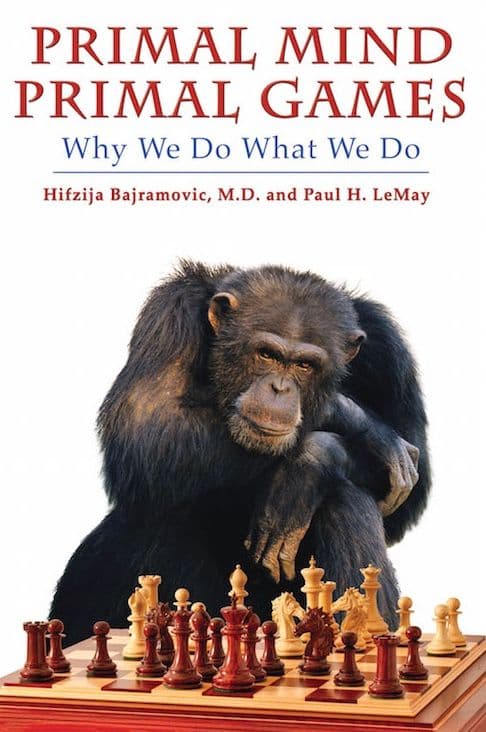
Primal Mind, Primal Games
Hifzija Bajramovic, M.D. and Paul H. LeMay · 2014
Over 50 years ago, 20th Century Fox released two blockbuster films – Stanley Kubrick's enigmatic 2001: A Space Odyssey, and the Sci-fi dystopia Planet of the Apes – Modern space-age tech juxtaposed against humanity's early primate nature. An apt description of where we still find ourselves today — one foot still in the jungle while another strides to the stars. But how is it that despite all of our technological modernity, we continue to live on a planet dominated by an ape mentality still obsessed with wanting to control most of the monetary bananas, weapons and political power? After millions of years of evolution, you'd think we'd be out of the ape psychology woods by now? So, what gives?
Is it simply because 99% of our human DNA is identical to that of chimpanzees? Or, is it because too many of us have yet to develop enough awareness about our higher order mental potential that we simply fail to tap into it, causing us to suffer?
Primal Process Theory suggests both.
Whether it's in our willingness to sometimes lord over others through various subtle and not-so-subtle forms of social intimidation, or in the bombast of our verbal attacks, or in the strong emotional connections we hold for our groups-of-origin, few of us realize just how many of our thoughts, words, actions and reactions reflect our biology's ape inheritance. Humanity's Primal Mind definitely reflects some of this inheritance. It's the deep operating system or program upon which humanity's more evolved mental capacities later emerged. Yet as intrusive and oppressive as this behavioral source code can sometimes be, it also gives rise to a limited number of predictable patterns. Primal Process Theory unpacks the nature and evolutionary origins of these patterns so you can more clearly see, navigate and ultimately rise above the forces running both the Primal Mind and the Primal Game in which our whole species is so unconsciously enmeshed. Towards this end, Primal Process Theory presents four simple keys that allow you to pick the locks to this long mysterious and imprisoning psychological vault.
Built on 10 years of comparative science research, and drawing on 40+ years of professional counselling experience, Primal Process Theory lets you understand how these four key components relate to one another so you need not remain at the mercy of the hidden programs shaping so much of why we do what we do. So the only question you need now answer is whether you want the keys to your mind's own cage?
In their words
Acknowledgement
We are equally appreciative of the painstaking hours that Evelyn Voigt also contributed to editing the early drafts if our manuscript. She was insistent on trying to make the language more palatable to a wider audience, and she provided valuable feedback on subsequent drafts.
Credits
Publication detailsISBN, publisher, format
- Publisher
- Parzival Press
- Published
- 2014
- Format
- Book